Our scienceThe formula
Meet the osmolyte stack
The six ingredients in HydroSure, the role each one plays in cells, and how strong the evidence is for each.
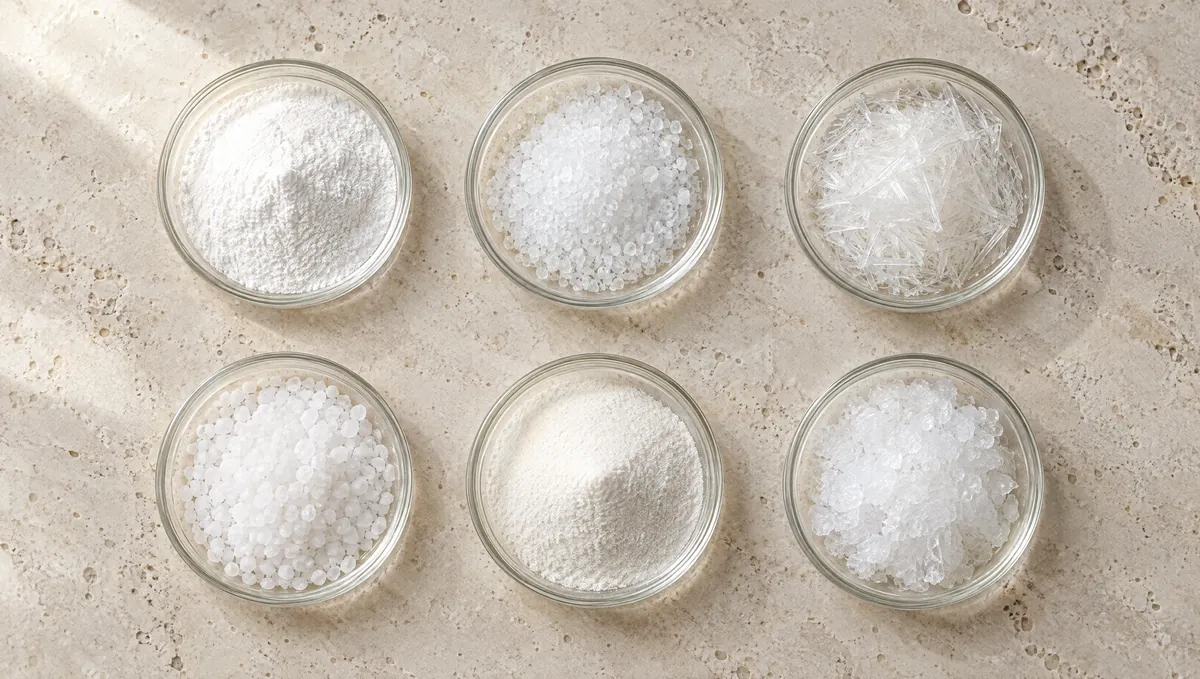
Most of us picture hydration as water moving through the body, from a glass on the counter or a bottle in the gym bag. Each of your cells also manages its own water, from the inside, all day long. HydroSure is built around that cellular side of hydration and around a small set of molecules called osmolytes that cells use to manage their water.
How cells hold their own water
Every cell has to manage its own water content. With too much water it swells too far, and with too little the processes inside it work less well. To hold the right amount of water, a cell needs dissolved particles inside it. The more particles it holds, the more water it tends to draw in and keep.
The obvious particles would be plain salts: sodium, potassium, chloride. At the high concentrations a cell would need, though, those inorganic ions start to distort the proteins doing the cell's work. Cells instead accumulate what scientists call "compatible" organic osmolytes, small organic molecules they can build up to hold water without disrupting protein function (Burg & Ferraris, 2008).
This is the idea behind "cellular hydration," and it's the strongest, least controversial part of the science. These molecules let a cell keep its water and volume without loading up on salt. HydroSure is built around six of them. It is not an electrolyte formula, and it contains no stimulants.
The six osmolytes
Each of these has been described as an intracellular organic osmolyte, but the evidence differs. Taurine and betaine are well-documented osmolytes in mammalian tissue, and creatine is one of the main osmolytes in the brain (Burg & Ferraris, 2008). For glycine, glutamine, and alanine, the evidence in human cells comes from cells grown in the lab (Franchi-Gazzola et al., 2006). Several also have other roles in the body. Together they come to 21 g of actives per serving, led by creatine and L-alanine.
Creatine monohydrate (5 g) is one of the most-studied compounds in sports nutrition. It also helps muscle cells hold water.* In the studies behind that, people began with five to seven days at 20 to 25 g a day, four to five times this dose (Saab et al., 2002; Powers et al., 2003). We list it first because its human evidence is the firmest of any ingredient here.
*These statements have not been evaluated by the Food and Drug Administration. This product is not intended to diagnose, treat, cure, or prevent any disease.
L-Alanine (5 g) is a metabolic shuttle. Through the glucose-alanine cycle, the body's own alanine carries nitrogen out of muscle in a manageable form and gives the liver raw material to make glucose (Holeček, 2024). This is free-form L-alanine, a different compound from beta-alanine, so it causes no tingling and is not a stimulant. Human cells grown in the lab take up alanine as an osmolyte when the surrounding fluid becomes more concentrated (Franchi-Gazzola et al., 2006), and shallow-water shellfish use it the same way (Burg & Ferraris, 2008). No study has tested whether alanine taken by mouth changes the water in your cells, and direct performance data for L-alanine are sparse.
Taurine (3 g) is one of the most abundant osmolytes in excitable tissue such as muscle, heart, and brain, at roughly 5 to 20 micromoles per gram, and it is involved in cell-volume regulation and membrane stability (Chen et al., 2021). Its exercise-performance data are mixed, so we lead with its established role in cell volume.
Glycine (4 g) is an inhibitory neurotransmitter, and cells use it as an osmolyte, mainly in shallow-water shellfish (Burg & Ferraris, 2008) and in human cells grown in the lab (Franchi-Gazzola et al., 2006). Its most-discussed human research is on sleep. In small studies, about 3 g taken before bed improved subjective sleep quality, and animal studies suggest it works partly by widening blood vessels near the skin (Ramos-Jiménez et al., 2024). HydroSure makes no sleep claim, and its directions are not a bedtime dose. Much of the broader performance and recovery evidence for glycine comes from animal and cell studies.
Glutamine (3 g) is one of the amino acids that cells concentrate through a transporter called SNAT2, and it makes up a large share of the free amino acids inside cells. In human cells grown in the lab, that uptake helps the cells recover their volume when the surrounding fluid becomes more concentrated (Franchi-Gazzola et al., 2006). The evidence comes from cells in the lab. No study has tested whether glutamine at this dose, taken by mouth, changes the water in your cells, so we describe how the molecule works and don't promise an outcome from it.
Betaine anhydrous (1 g), also called trimethylglycine or TMG, has two roles. It is an osmolyte that cells use to defend their volume under stress, and it is a methyl donor, a molecule that hands off a chemical group the body uses in normal metabolism (Lever & Slow, 2010). Studies of betaine and strength or power used about 2.5 g a day (Lee et al., 2010), more than the 1 g here. We include it for its osmolyte and methyl-donor roles and make no promise of strength or power gains. Endurance evidence is limited and inconclusive either way (Perreras & Kim, 2025).
What "compatible" means
A cell could, in principle, defend its water with salt. It relies on compatible osmolytes instead, because they let it hold water while keeping its proteins folded and working. That is the biology HydroSure is built on. HydroSure is not an electrolyte formula, so if you're training long or in the heat, get electrolytes from food or a separate product.
What the evidence supports
The evidence falls into three groups.
- Well established. Cells use compatible organic osmolytes, rather than extra salt, to keep their volume without disrupting protein function. Taurine and betaine are well-documented examples in mammalian tissue, and creatine is one in the brain.
- Human signals, still modest. Creatine raised body water in human studies, mostly ones that began with several days of high doses, and it is well studied for muscle at about 5 g a day. Glycine improved subjective sleep quality in small trials of about 3 g at bedtime, which is not how HydroSure is used.
- Mixed, limited, or mostly mechanistic. This covers taurine for exercise performance, betaine for strength, power, and endurance (its strength and power trials used about 2.5 g a day, more than our 1 g), glutamine and alanine for performance in healthy, well-fed people, and the osmolyte role of glycine, glutamine, and alanine in human cells, which rests on lab studies. Here the evidence is stronger on mechanism than on outcomes.
So we don't claim that HydroSure boosts strength, builds muscle, or guarantees a result. The cell biology behind it is well established. No study has tested the formula itself, and the evidence on performance and recovery is modest.
The bottom line
HydroSure is a dietary supplement built around how cells hold water. Its six actives are creatine, L-alanine, taurine, glycine, glutamine, and betaine, chosen because cells use molecules like these to manage their water. Together they come to 21 g per serving. The cell biology is well established, the human evidence is strongest for creatine, and the performance evidence is modest.
References
- Burg MB, Ferraris JD. "Intracellular Organic Osmolytes: Function and Regulation." Journal of Biological Chemistry (2008). pmc.ncbi.nlm.nih.gov
- Chen Q, et al. "The Dose Response of Taurine on Aerobic and Strength Exercises: A Systematic Review." Frontiers in Physiology (2021). pmc.ncbi.nlm.nih.gov
- Lee EC, et al. "Ergogenic effects of betaine supplementation on strength and power performance." Journal of the International Society of Sports Nutrition (2010). pmc.ncbi.nlm.nih.gov
- Perreras MSL, Kim J. "Effects of betaine supplementation on endurance exercise performance: a systematic review." Physical Activity and Nutrition (2025). pmc.ncbi.nlm.nih.gov
- Ramos-Jiménez A, et al. "An Update of the Promise of Glycine Supplementation for Enhancing Physical Performance and Recovery." Sports (Basel) (2024). pmc.ncbi.nlm.nih.gov
- Holeček M. "Origin and Roles of Alanine and Glutamine in Gluconeogenesis in the Liver, Kidneys, and Small Intestine." International Journal of Molecular Sciences (2024). pmc.ncbi.nlm.nih.gov
- Franchi-Gazzola R, et al. "The role of the neutral amino acid transporter SNAT2 in cell volume regulation." Acta Physiologica (2006). pubmed.ncbi.nlm.nih.gov
- Lever M, Slow S. "The clinical significance of betaine, an osmolyte with a key role in methyl group metabolism." Clinical Biochemistry (2010). pubmed.ncbi.nlm.nih.gov
- Saab G, et al. "Changes in human muscle transverse relaxation following short-term creatine supplementation." Experimental Physiology (2002). pubmed.ncbi.nlm.nih.gov
- Powers ME, et al. "Creatine Supplementation Increases Total Body Water Without Altering Fluid Distribution." Journal of Athletic Training (2003). pmc.ncbi.nlm.nih.gov