Our scienceLongevity
Cellular hydration and longevity
How your cells hold water, and what studies of hydration and aging can and can't show.

Most of us think of hydration as intake, drinking enough to stay topped up. Cells also manage how much of that water they hold, and HydroSure is built around that biology. This article explains how cells hold water and what research on hydration and aging has found, including where it stops.
How body water changes with age
Water makes up half or more of your body weight, and the share changes over a lifetime. In one clinic study that measured body water by bioimpedance, total body water ran around 62% of body weight in normal-weight adult men and 54% in normal-weight adult women. It was lower in people over 60, at roughly 57% in men and 50% in women, though that oldest group was small (Lu et al., 2023). The authors attribute the drop to lower muscle mass, and muscle is one of the most water-rich tissues in the body.
Thirst changes too. As we get older, the sense of thirst can become blunted, especially after the body has lost water, so staying well hydrated later in life can take more conscious effort (Kenney & Chiu, 2001). This is a normal part of aging, and a good reason to pay attention to everyday hydration as the years go on.
Cell volume as a metabolic signal
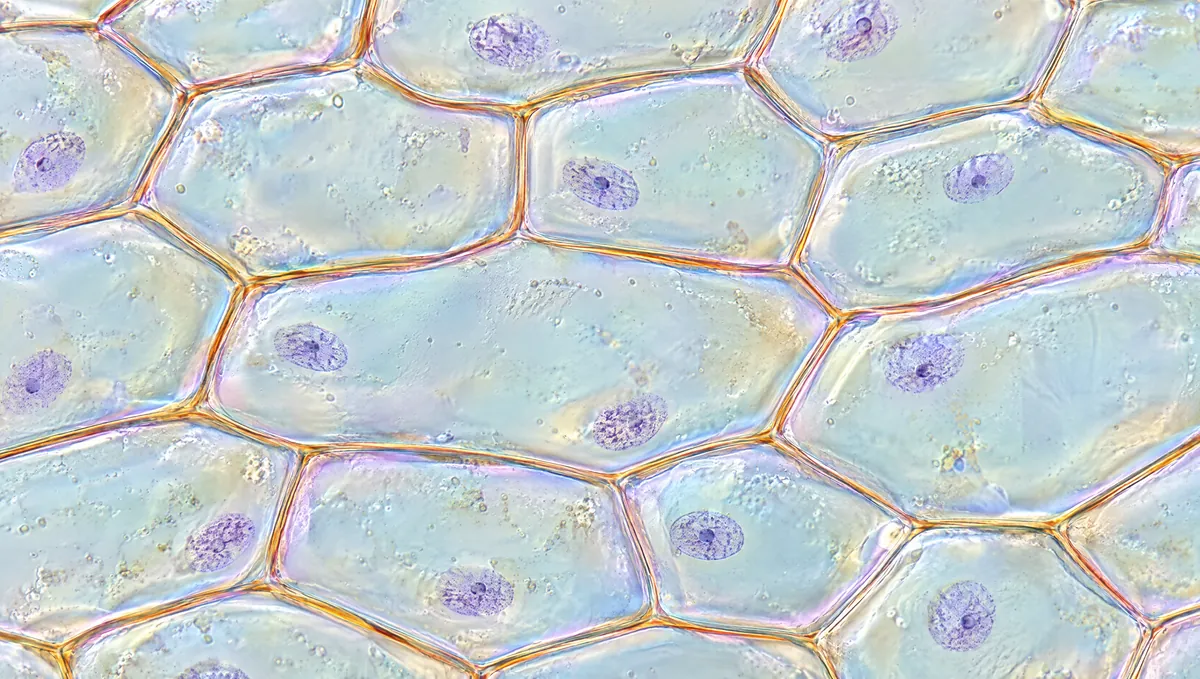
A cell actively manages how much water it holds, and its volume acts as a kind of metabolic signal. Research in cell physiology describes how a well-hydrated, slightly swollen cell leans toward building, supporting processes like protein synthesis and glycogen storage, while a shrunken cell leans toward breakdown (Lang, 2011).
Cells also work to keep their volume in a narrow range. After swelling or shrinking, they move ions and osmolytes to restore it, so the aim is a steady volume, not as much water as possible (Lang, 2011).
How cells hold water
A cell could take on more water by loading up on salt, but high salt levels would disrupt the proteins and enzymes inside it. Instead, cells use what physiologists call compatible osmolytes. These are small organic molecules that a cell accumulates to raise its internal solute concentration and keep its volume. "Compatible" means they do this without interfering with how proteins and enzymes work (Burg & Ferraris, 2008).
The osmolytes most relevant here are taurine, glycine, glutamine, alanine, betaine, and creatine, and the evidence differs among them.
- Taurine is one of the most abundant free amino acids inside your cells and a major organic osmolyte. It's concentrated in tissues like muscle, heart, and brain, where it helps regulate cell volume (Ripps & Shen, 2012).
- Creatine can also act as a compatible osmolyte. In mouse muscle cells grown in the lab, it helped the cells survive when the surrounding fluid was made more concentrated, about as well as betaine, taurine, and myo-inositol did (Alfieri et al., 2006).
- Glycine, glutamine, and alanine act as osmolytes in human cells grown in the lab, when the surrounding fluid becomes more concentrated (Franchi-Gazzola et al., 2006).
Whether taking any of these as a supplement changes the water inside your cells has not been tested in healthy people.
What studies of hydration and aging found
Two large population studies have linked a marker of hydration to biological aging.
In an analysis of the long-running ARIC study, researchers followed 11,255 adults for about 25 years. People whose serum sodium in middle age sat in the upper part of the normal range, a marker associated with habitually lower hydration, tended to show markers of faster biological aging. The most favorable outcomes clustered around 137 to 142 mmol/L (Dmitrieva et al., 2023). A separate analysis of NHANES data (18,301 adults) reported a similar U-shaped pattern, with estimated biological age lowest near 139 mmol/L (Tong et al., 2025). Finding a similar range in two independent datasets makes the pattern more convincing.
Both research teams describe these findings as associations that do not establish cause. Neither study shows that drinking more water, or taking any supplement, changes how you age. The authors note that randomized trials are still needed. The patterns describe serum sodium across populations and say nothing about the effect of any product.
Our claims stay within that evidence. Drinking enough water is a sensible everyday habit at any age, but no one can honestly say that hydration slows or reverses aging, and we make no such claim.
The bottom line
Good hydration starts with enough total water. A useful reference point is about 2.0 L a day for women and 2.5 L for men under moderate conditions, counting water from food and all beverages (EFSA, 2010). Thirst can fade with age, so a routine for drinking water matters more later in life. The studies linking hydration to aging are associations, and they do not show that any product changes how you age.
References
- Lu H, Ayers E, Patel P, Mattoo TK. "Body water percentage from childhood to old age." Kidney Research and Clinical Practice, 2023. pmc.ncbi.nlm.nih.gov
- Lang F. "Effect of cell hydration on metabolism." Nestlé Nutrition Institute Workshop Series, 2011. pubmed.ncbi.nlm.nih.gov
- Ripps H, Shen W. "Review: Taurine: A 'very essential' amino acid." Molecular Vision, 2012. pmc.ncbi.nlm.nih.gov
- Alfieri RR, Bonelli MA, Cavazzoni A, et al. "Creatine as a compatible osmolyte in muscle cells exposed to hypertonic stress." The Journal of Physiology, 2006. pmc.ncbi.nlm.nih.gov
- Dmitrieva NI, Gagarin A, Liu D, Wu CO, Boehm M. "Middle-age high normal serum sodium as a risk factor for accelerated biological aging, chronic diseases, and premature mortality." eBioMedicine, 2023. pmc.ncbi.nlm.nih.gov
- Tong X, Wang F, Liu M. "Serum sodium within the normal range and its U-shaped relationship with biological aging in U.S. adults." Frontiers in Nutrition, 2025. pmc.ncbi.nlm.nih.gov
- EFSA Panel on Dietetic Products, Nutrition and Allergies (NDA). "Scientific Opinion on Dietary Reference Values for water." EFSA Journal, 2010. efsa.onlinelibrary.wiley.com
- Kenney WL, Chiu P. "Influence of age on thirst and fluid intake." Medicine and Science in Sports and Exercise, 2001. pubmed.ncbi.nlm.nih.gov
- Burg MB, Ferraris JD. "Intracellular Organic Osmolytes: Function and Regulation." Journal of Biological Chemistry, 2008. pmc.ncbi.nlm.nih.gov
- Franchi-Gazzola R, Dall'Asta V, Sala R, et al. "The role of the neutral amino acid transporter SNAT2 in cell volume regulation." Acta Physiologica, 2006. pubmed.ncbi.nlm.nih.gov