Our scienceMechanism
Cellular hydration, explained
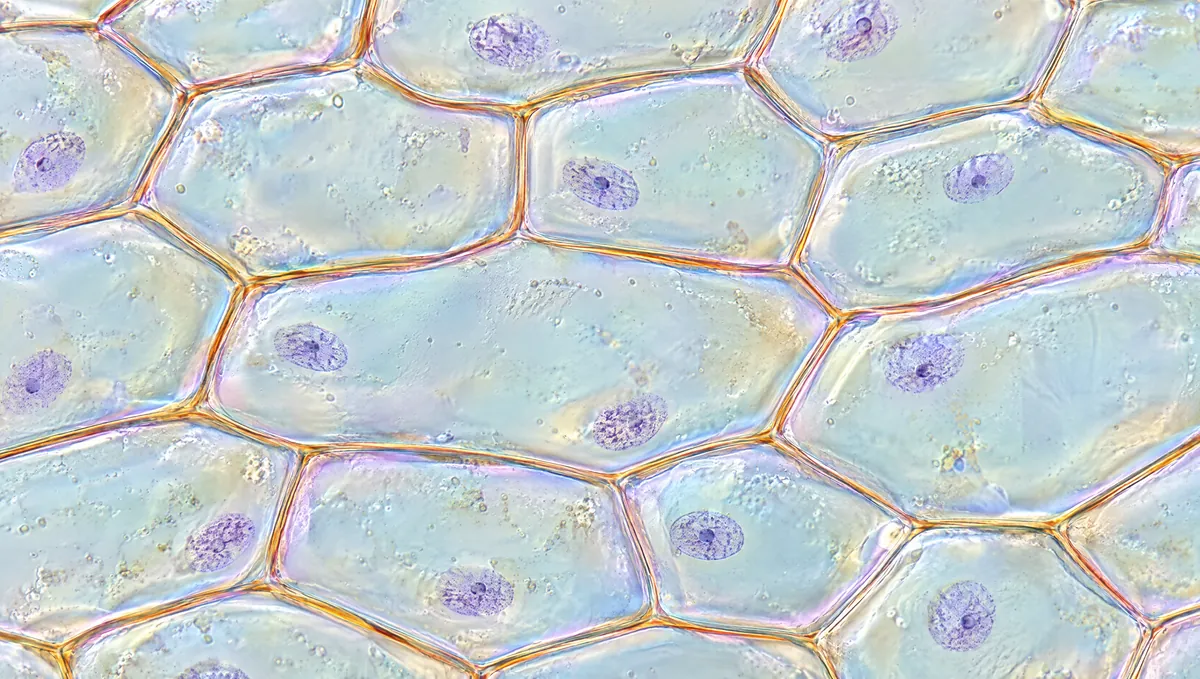
Most of the water in your body sits inside your cells. Dissolved particles, including small molecules called osmolytes, determine where it goes.
Drinking water is the first step in hydration. Where that water goes next depends on chemistry, and HydroSure is built around that idea.
Your body keeps water in two places
In a healthy adult, water makes up roughly 50 to 60% of body weight. Most of it sits inside your cells (intracellular fluid). The rest sits outside them, in blood and the spaces between cells (extracellular fluid).
Physiology teaching sums this up as the "60-40-20 rule." About 60% of body weight is water, about 40% of body weight is the water inside cells, and about 20% is the water outside them. For a 70 kg adult, that's roughly 42 liters of water in total, with about 28 liters inside cells and about 14 liters outside. That is two-thirds inside and one-third outside.
The split matters because the two compartments behave differently and fill in different ways.
Water follows dissolved particles
Water tends to go where the dissolved particles are. Cell membranes are highly permeable to water, so water crosses them readily in both directions. Its movement follows osmolality, the concentration of dissolved particles (salts, minerals, small molecules) on each side of the membrane. Water tends to flow toward whichever side has more particles until the two sides balance. In healthy blood, osmolality stays in a tight band, around 275 to 295 mOsm/kg. The water you drink spreads between the compartments along these gradients, and your kidneys and sense of thirst help keep the whole system in balance.
So where water settles depends on the balance of particles, and each compartment holds water with different ones.
Different particles hold water inside and outside cells
Outside your cells, sodium is the dominant particle. With its partner ions, it accounts for the great majority of the solute in extracellular fluid, so sodium is largely what holds water outside the cells.
Inside your cells, different particles hold the water: potassium, plus a group of small molecules called organic osmolytes. Taurine and betaine (trimethylglycine) are well-documented examples, and creatine acts as one too. In human cells grown in the lab, neutral amino acids such as glycine, glutamine, and alanine do the same job when the surrounding fluid becomes more concentrated. Cells adjust their stores of these molecules to keep their volume steady.
This matters when you sweat. Sweat carries away more water than salt, so heavy sweating leaves the fluid outside your cells more concentrated, and water moves out of the cells to balance it. When you replace the lost water, with or without some sodium, the fluid outside your cells becomes less concentrated again, and water moves back into the cells by osmosis. The sodium in a classic sports drink mainly helps restore the volume of fluid outside the cells.
How cells pull water in
Cells actively manage their own volume, and organic osmolytes are one of the ways they do it. A cell can accumulate or release them to adjust its internal particle load, drawing water in or letting it out. Cells take up taurine, for example, to defend their water under high-particle stress, and release it when conditions ease. They are called "compatible" osmolytes because they do this without disrupting the proteins working inside the cell. This is core, well-documented cell physiology.
Creatine is one example that has also been studied in people. Muscle cells take it up through a dedicated sodium-linked transporter. In mouse muscle cells grown in the lab, creatine helped the cells survive when the surrounding fluid was made more concentrated, about as well as betaine, taurine, and myo-inositol did. In one controlled study of 32 resistance-trained men and women, creatine raised total body water. That study began with a week at 25 g a day before stepping down to 5 g a day. The rise in intracellular water did not reach statistical significance on its own, though, and overall fluid distribution stayed normal.
Swelling and shrinking can also act as signals that influence a cell's metabolic and signaling pathways. That mechanism is well characterized in cell studies. The evidence is thinner on how much it matters for everyday wellness, and no study has tested whether HydroSure changes it.
What HydroSure is designed to do
HydroSure is built around how cells hold water. It pairs creatine, which helps muscle cells hold water,* with five amino-acid osmolytes (alanine, taurine, glycine, glutamine, and betaine), the small molecules cells use to manage their water. Each serving has 21 g of these actives. Whether taking osmolytes as a supplement changes the water inside your cells is not established in healthy people.
*These statements have not been evaluated by the Food and Drug Administration. This product is not intended to diagnose, treat, cure, or prevent any disease.
HydroSure is not an electrolyte formula, and it contains no stimulants. If you're training long or in the heat, get electrolytes from food or a separate product.
The bottom line
Most of your body's water sits inside your cells, and how much stays there depends on both how much you drink and the particles your cells use to hold it. Water and sodium are both essential. Sodium does most of its work in the fluid outside your cells. HydroSure is built around the inside of the cell, with creatine and five amino-acid osmolytes.
References
The physiology here is foundational and well-established: two body-water compartments, osmolality driving water movement, and organic osmolytes in cell-volume regulation. The evidence for glycine, glutamine, and alanine as osmolytes comes from cells grown in the lab. These are the sources behind the specific claims above.
- Physiology, Water Balance. StatPearls, NCBI Bookshelf. ncbi.nlm.nih.gov
- Physiology, Body Fluids. StatPearls, NCBI Bookshelf. ncbi.nlm.nih.gov
- Physiology, Plasma Osmolality and Oncotic Pressure. StatPearls, NCBI Bookshelf. ncbi.nlm.nih.gov
- Strange K. "Cellular volume homeostasis." Advances in Physiology Education, 28(1-4):155-159 (2004). journals.physiology.org
- Alfieri RR, et al. "Creatine as a compatible osmolyte in muscle cells exposed to hypertonic stress." The Journal of Physiology, 576(Pt 2):391-401 (2006). pmc.ncbi.nlm.nih.gov
- Powers ME, et al. "Creatine Supplementation Increases Total Body Water Without Altering Fluid Distribution." Journal of Athletic Training, 38(1):44-50 (2003). pmc.ncbi.nlm.nih.gov
- Franchi-Gazzola R, et al. "The role of the neutral amino acid transporter SNAT2 in cell volume regulation." Acta Physiologica, 187(1-2):273-283 (2006). pubmed.ncbi.nlm.nih.gov